
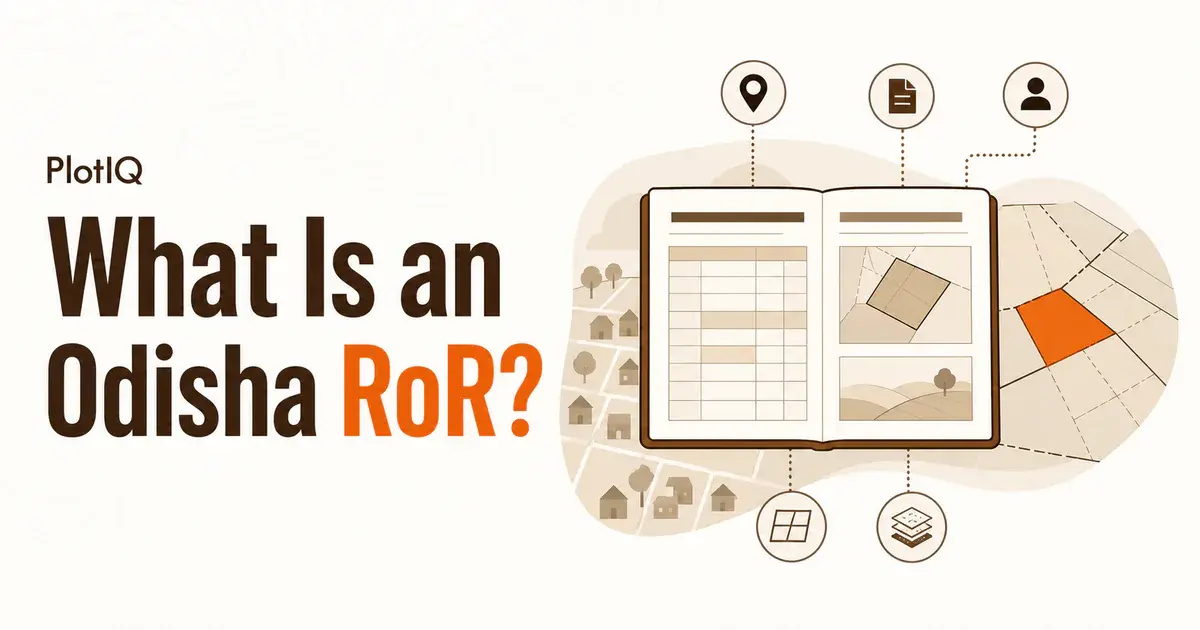
An Odisha Record of Rights (RoR) is a land-revenue record showing recorded names, plots, area, land classification and revenue details for a Khata/Khatiyan. It helps you understand the recorded holding, but it is not a complete ownership check.
What information does an RoR show?
| Part | What to read |
|---|---|
| Location and record reference | District, Tahasil, village and Khata/Khatiyan number |
| Front page | Recorded tenant names and revenue details such as rent and cess |
| Back page | Plots attached to the record, with their area and classification where shown |
| Remarks | Additional entries relevant to the record, where available |
The front/back distinction is explained in the official Bhulekh FAQ. Exact fields can vary by record. Rules 21–23 of the Survey and Settlement Rules describe the particulars recorded and distinguish the Khatian from the map.
A single Khata/Khatiyan can contain several plots. Tenant is a revenue-record term, and Kisam means the recorded land classification. See the Odisha land-record glossary for the full definitions.
Read the record in four checks
- Location: match the district, Tahasil and village with your document.
- Record and names: match the Khata/Khatiyan number and read all recorded names, including joint entries.
- Plots: check the expected plot numbers, area units and Kisam on the plot-details page.
- Remarks: read relevant notes and compare them with your deed or earlier record. Keep the date of your lookup.
To find the record first, follow the Bhulekh Odisha lookup steps. Use the portal's Map View for the separate cadastral map.
What an RoR cannot confirm on its own
An RoR alone does not establish a complete chain of ownership, absence of encumbrances, the current physical boundary or permission to build. The Supreme Court's 12 December 2024 order confirms that mutation entries do not themselves confer title. Revenue records can still be relevant evidence; they are not the entire title history.
For a transaction or dispute, use the other records and professional checks appropriate to that purpose.
Common questions
Is an RoR the same as a sale deed?
No. A sale deed records a transaction; an RoR is a revenue record. A change may be reflected in the RoR through mutation. Keep both documents when comparing an entry.
Can I print the RoR?
Yes. The official user manual describes a Print option. Ask the receiving office whether a reference printout is sufficient or a certified copy is required.
What if the entry is missing or outdated?
First recheck the selected location and number. The manual describes daily data updates, but that does not mean every pending mutation or correction has been completed. Use Contact Us on Bhulekh to find the concerned Tahasil.
If the recorded holder has died, see adding heirs’ names through Odisha patta mutation, with an Odia video and a preparation checklist.
PlotIQ is an independent information service. It cannot certify or correct government records.