
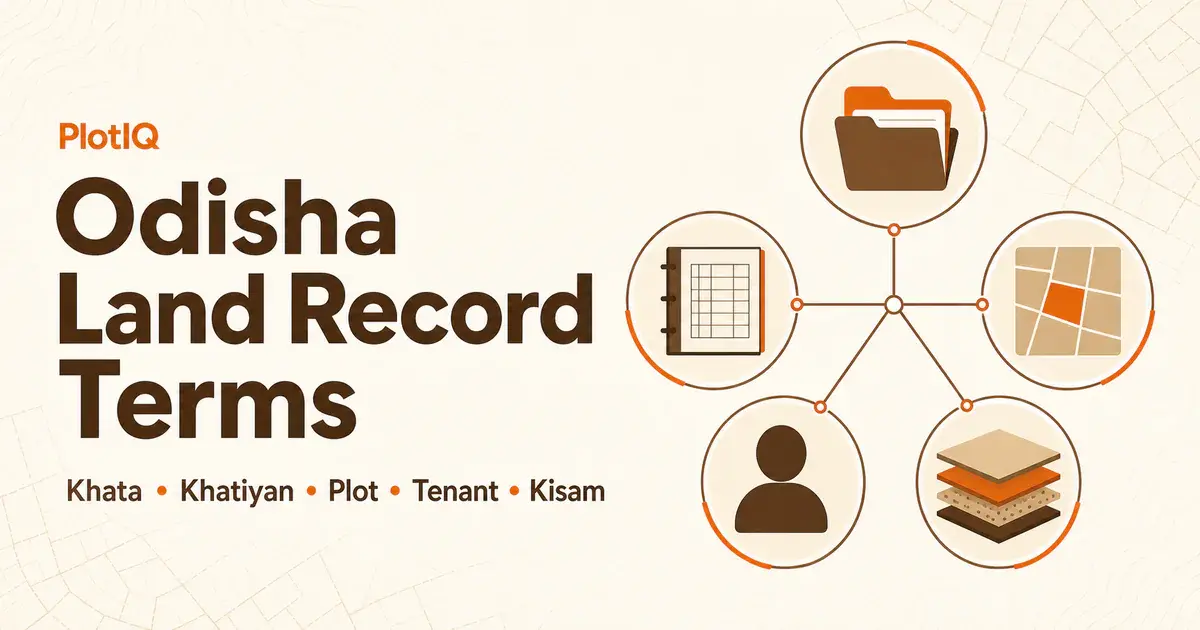
In Odisha land records, Khata/Khatiyan identifies the revenue record, plot identifies a parcel entry, tenant refers to a recorded person, and Kisam describes the plot's recorded land classification. Read these fields together and match the district, Tahasil and village.
The five terms at a glance
| Term | What it means in an Odisha record |
|---|---|
| Khata | The numbered revenue account or holding reference shown in land documents. It can include more than one plot. |
| Khatiyan / Khatian | The textual record of rights; Khatiyan is also the search option used by Bhulekh. |
| Plot number | The number identifying a parcel entry within the selected revenue village. |
| Tenant | The person or people entered in the revenue record. It does not necessarily mean a renter in the everyday sense. |
| Kisam / Kissam | The recorded land classification attached to a plot. |
The official Odisha model sale deed has separate fields for the Khata number, plot number, Kisam and area.
Are Khata and Khatiyan the same?
The terms are closely related and sometimes used interchangeably. Khata number commonly identifies the account or holding; Khatiyan refers to the record and is the portal's lookup label. Use the exact label and number on your document rather than assuming every source makes the same distinction.
Rules 21–23 of the Survey and Settlement Rules describe the recorded particulars, a Khatian for a person or jointly interested group, and the map separately.
One Khata can contain several plots
Here is a fictional example:
| Field | Example |
|---|---|
| Village | Example Mouza |
| Khata/Khatiyan | 123 |
| Recorded people | Person A and Person B |
| Plots | 456 and 457 |
| Area and Kisam | Read separately for each plot |
The record groups the two plots under the same Khata/Khatiyan. Their areas or classifications may differ. Plot 456 in another village is not identified as the same land merely because the number matches.
Three common confusions
- Khata number versus plot number: one identifies the record; the other identifies a parcel entry. Match both where available.
- Tenant versus verified owner: the name is a revenue entry, not a complete ownership conclusion. Read joint names and supporting documents too.
- Kisam versus building permission: a recorded classification alone does not grant permission to construct or change land use. Check the applicable approvals separately.
Where to find these details
The Bhulekh FAQ directs readers to the front page for tenant and revenue details, and the back page for plot details. Check each relevant plot row and its area unit; numbers from different villages or document dates may not refer to the same record.
For a mismatch, keep the documents and contact the concerned Tahasil. Mutation entries do not by themselves confer title, as the Supreme Court explains.
Next, find your RoR on Bhulekh or learn how to read an Odisha RoR.
PlotIQ provides independent explanations and is not affiliated with the Government of Odisha.